Beginnings of a Municipal Airport
By Claudine Burnett
Published: November 3rd, 2023
On November 26, 2023, Long Beach Airport will be celebrating its 100th anniversary, but many may not be aware that it’s not the city’s first landing field.
The Beach
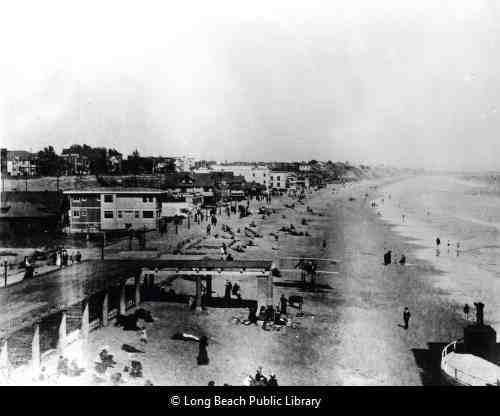
 The first home to Long Beach aviation was along the city’s downtown shore, where aviators took to the air, inspired by the 1910 Dominquez International Air Meet, the first air meet held in the United States, and the second in the world (France held the first in 1909). Tourists were delighted having these air machines close by, but things changed. In 1916, residents along Ocean Avenue began to complain about the noise. A petition bearing the names of more than 200 Long Beach citizens was submitted to City Commissioners. In it they characterized flying as “a nuisance and menace to human life as well as a danger to hundreds of people who used the beach.” In view of this petition and many previous complaints about airplane noise, local aviators Earl Daugherty, Harry Christofferson, Thor Polson and Jay Boyd decided to move to Seal Beach. The nearby beach resort had established an entertainment zone similar to the Pike. Amusement men there were quick to realize the value of the airplane in drawing crowds. As an enticement to aviators, they erected three airplane hangars and offered free rentals to aviators who moved there.
Many Long Beach residents expressed regret over losing the seafront aviation field, feeling Long Beach had lost a valuable asset in attracting large crowds and providing thrills for visitors. In addition, they believed the city had lost the chance to become the aviation center of Southern California. But the new flying field in Seal Beach was not to last. On April 2, 1917, America entered the war in Europe. For Long Beach aviators the war was just another adventure, and an opportunity to prove the value of aviation. For Earl Daugherty and Jay Boyd, assigned as Army flight instructors, it was a chance for them to continue to spread aviation fever by teaching others to fly.
Chateau Thierry
 Shortly before World War I, Earl Daughtery and his father purchased a 20-acre site at Bixby Road (near Wardlow) and Long Beach Boulevard. Earl planned to use it was a flying school, but the war interrupted his plans.
Born in Des Moines Iowa in 1887, Earl Daugherty had lived in Long Beach most of his life. Graduating from Long Beach High School he went to work in a bank where he might have remained if he hadn’t caught aviation fever at the Dominguez Air Meet in 1910. Two years later he was a pilot traveling to the Chicago National Air Races where he won $1000 ($31,100 in 2022). With that money he purchased a Borel-Morante monoplane, considered one of the fastest airplanes of its day. To many he was known as the “father” of Long Beach aviation.
On June 6, 1919, the aviator opened the Daugherty School of Aviation, with passenger carrying on the side. It was close to a new Long Beach subdivision, christened “Chateau Thierry” in honor of America’s great World War I battle in France. Daugherty’s new operation was highly successful. Records show he carried 1,785 passengers that first year. Daugherty, a flight instructor during the war, also began to train stunt flyers such as Wesley May, Clarence “Ace” Bragunier, Augie Pedlar and Frank Hawks.
Planes were still a rarity in most parts of the United States and just the noise of an airplane engine churning across the sky was enough of a novelty in itself to bring people outside to stare upward. By 1923 there were about 300 barnstormers touring the country exhibiting their flying skills and stunts. Daugherty, was different. Earl had had enough of barnstorming before the war; he was now one of the very first “fixed-base operators”— one who operated continuously from a single flying field. His students, however, toured in organized groups, or as individual stunt artists. Daugherty, however, believed aviation had a more important future than just entertainment and he was eager and willing to explore other prospects.
On May 29th 1919, tentative plans to establish passenger, express and mail airplane service in California, with Long Beach as a terminal, were outlined to Chamber of Commerce officials by representatives of the United States Aero Transportation Company. Four large planes, each capable of carrying twelve passengers, two flying north to San Francisco and two flying south to San Diego, would stop at Long Beach daily. A branch line from Long Beach to Catalina would also be considered if Long Beach spent an estimated $25,000 ($423,000 in 2022) to build a terminal. To finance this, the United States Aero Transportation Company said, stock could be sold to Long Beach investors, with the proviso that the money be spent on the local terminal, which had to be spacious and equipped with shops, hangars, tanks and a macadamized field. The Aircraft Equipment Company of Los Angeles, also anxious to cash in on this new business of aviation, approached the City of Long Beach on April 28, 1920, proposing a regular air jitney service between Long Beach and San Diego for a $10,000 ($146,000) investment. Yet they too needed a proper terminal.
Long Beach’s First Municipal Airport

Aviator Earl Daugherty saw the opportunities aviation presented. He was just getting started.
On July 16, 1920, Daugherty received official city endorsement to develop a municipal flying field on land situated west of Long Beach Boulevard, and south of Willow. This low-lying land, purchased by Daugherty and not suitable for residential or other uses, would be filled in by the city, turning it into a municipal flying field. Arrangements were made between Daugherty and the City of Long Beach to grade, level and fill the 60 acres where needed. 7,000 cubic yards of dirt were placed in the hollows but much of the field was already so level it required little fill. All that was needed was three to four inches of decomposed granite spread over the surface of the acreage to put it in ideal condition. In consideration for his help, the name Daugherty Municipal Aviation Field was agreed upon. Long Beach was now one of a few Western cities to have a municipal airfield, one open to all visiting aviators and Army and Navy flyers free of charge.
The grand opening and dedication of the Long Beach Municipal Aviation Field took place on Christmas day 1920 during the Aero Club of Southern California’s National Flying Show and Races held on December 25, 26 & 27, 1920. Over 2500 paid admissions were recorded each day. Daugherty told the Daily Telegram why the Long Beach field was the most ideal of all the aviation fields in Southern California:
“Many cities have landing fields, but most of these fields are away from car lines and not convenient to the center of cities. The new Daugherty Municipal Flying Field is ideally located, on the main boulevard, leading into town, on a main car line, five minutes’ drive from the post office and express companies. It will be but a very short time until a great deal of mail and express will be delivered by airplane to every city having a handy and first-class flying field. Long Beach is far ahead of all the other Southern California cities by having the field convenient.”
At the dedication, there were thrills a plenty. Nineteen-year-old stunt walker Wesley May amazed spectators by standing on his head on the wing of Daugherty’s aircraft while the plane was landing, setting a world’s record. Also featured was a spectacular 20-mile race between two women pilots, Aloysia McLintic, a pupil of Daugherty’s, and Neta Snook. The two raced over the course in the first all-female air race ever held in Southern California. (Sorry, no report on who won).
The three major races were a 100-mile free-for-all race, an 80-mile handicap race and a dirigible airship race. The dirigible competition fascinated many, not just because there were only two such craft in the area, the Goodyear “Pony Blimp” and a Navy “C” type blimp, but because famous movie actress Coleen Moore was present to start the race, which the Navy won. Exhibits also attracted attention, such as: a 220-horsepower French “Spad” plane, used extensively by American aviators overseas; a huge working model of a 700-pound Liberty motor; the Goodyear blimp; a Boeing seaplane; two huge passenger planes; and a $15,000 ($219,000) all-metal airplane.
Long Beach was very fortunate to have Earl Daugherty and his $4500 ($66,000) a year aviation business in the city. Besides carrying an average of 35 passengers every Sunday and many others during the week, Daugherty was also a director of the Aero Club of Southern California, which was in the process of creating “air taxi” stations in various cities. In July 1922, Daugherty revealed plans for regular passenger airplane service between Long Beach and San Diego. The running time would be a little more than an hour, and the fare slightly more than rail fare. One advancement was that the planes would be equipped with a radio telephone which meant direct radio communication could be maintained between plane and both flying fields at all times during its flight.
Today’s Municipal Airport
 In June 1921, oil on nearby Signal Hill heralded tremendous growth in the Long Beach area. By 1923, subdivisions were growing up around the Daugherty-Municipal aviation field at Willow and Long Beach Boulevard at an incredible pace, and there was talk of expanding Pacific Avenue through the flying field. When Daugherty purchased the land, it had been inexpensive. No one wanted it. Real estate developers had shunned the Willow Street acreage because of unpredictable flooding and mosquitoes. Daugherty had been able to expand his aviation field south of the willow thickets, near Long Beach Boulevard where a shallow lake partially dried up under summer heat then refilled with winter rains. By draining the lake and grubbing out willow trees the airstrip had room to grow. But by 1923 residential tracts were pushing from the south and Long Beach city fathers restricted the airport’s Pacific Avenue crossing.
In September 1923, City Manager Charles Windham recommended that a municipal airport be established in the somewhat swampy area known as “water lands” at Cherry and Spring Street. Captain A.W. Marshall, commander of the Naval aircraft squadron of the battle fleet urged, that the new field be municipally owned:
“There is an old saying that necessity knows no law. The city that is not far-sighted enough now and arranges for and provides adequate airports for the use of planes, will be compelled, at no very distant date, to provide fields at enormous increase in price, because I believe that air travel will soon be considered, like the automobile a necessity. Unless the field is municipally owned, there is liable to come a time when the money value of the field divided into building lots will cause the owner to so divert it. Thus, the airports will be moved farther out, and, as the city develops, yet still farther, until they cease to be convenient to the city.”
Captain Marshall also pointed out that the Long Beach harbor was becoming more and more a Navy base, and as use of airplanes increased in the fleet, the need for a suitable airfield became more important.
Earl Daugherty believed the new city airport site to be ideal, and offered to donate his services and supervise its development and operation. Access to the airport would be free to federal fliers, he recommended, and a nominal charge could be imposed on other fliers as a means of covering running expenses.
The new airport was on land originally owned by the Montana Land Company, purchased in 1894 by millionaire Montana Senator William A. Clark and his younger brother James. In 1892, James moved from Montana to Los Angeles and picking up on Llewellyn Bixby’s vision of a vast sugar beet empire, acquired 8000 acres of the Los Cerritos ranch for $400,000 ($14 million in 2022). The acreage purchased by the Clarks extended from Signal Hill to the City of Bellflower, and east of Cherry to the San Gabriel River. Sugar beets were planted and the town of Los Alamitos gradually emerged around the area’s sugar beet factory. In 1911, the City of Long Beach obtained several hundred acres of water-bearing land from the Montana Land Company. At that time the city was concerned about a future water supply to support growth, little realizing that the land would become home to the city’s airport.
On November 26, 1923, the first earth was turned on what Long Beach City Manager Charles Windham stated would be one of the largest and most complete airports in the United States. Daugherty supervised the operations and predicted that within a year there would be such tremendous use of the airport that a bus line would have to be established to the site. He was also confident that the U.S. Navy would establish permanent hangars on the Long Beach field. “Long Beach is the only city on the coast that has been far-sighted enough to set aside a great tract of land for this purpose,” he said in an article in the Long Beach Press on December 8, 1923.
“In the future the Long Beach municipal aviation field will mean to visiting aviators everything that a perfectly kept auto camping ground now means to the automobile tourist. The field will offer cheap rent for hangar space, and will be as perfect a way station for gasoline, oil and repair work as any automobile garage. At least twenty-five air ships owned in Long Beach will be stored at the new field after the big steel hangars are ready for use, and the field itself will be one of this city’s greatest advertising assets.”
On December 20, 1924, the new municipal airport at Cherry Avenue and Spring Street was officially dedicated. Under the auspices of the Aero Club, one of the most spectacular flying meets ever held marked the dedication of the current Long Beach Airport.
A two-day program of exhibition flying and competitive events opened with a relay race and stunt activities. As evening fell a “flaming comet” streaked across the sky, which in reality was a plane brilliantly aflame with fire-flags. There was some discontent among the crowd when the wedding that was to have been held in the air was postponed. It seemed the groom, who was two months shy of 21, could not obtain a marriage license. The wing walking and dead stick landing contests, however, made up for the audience’s disappointment.
You will find more about the history of Southern California aviation in my book Soaring Skyward: A History of Aviation in and Around Long Beach, CA.
Categorized under: