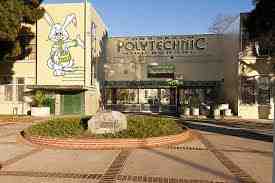
Racial Unrest at Poly High School
By Claudine Burnett
Published: September 13th, 2019
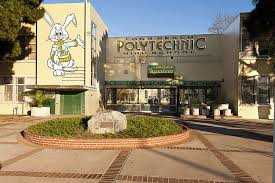 It started with a fistfight between an African American and a white student on April 11, 1966. The two were members of the same off campus musical combo. Race wasn’t the issue, but it ended up becoming one. After a school employee broke up the fight some students felt the African American student was physically mistreated in the process, more so than the white student. As a symbol of unity, most African American members of the Poly track team declined to participate in a meet with Wilson High the following day. They stressed it was a gesture of protest against the way their fellow student had been treated; it was not directed at the track team coaches. Suspensions followed.

Later that month, members of the African American community held picket signs outside Poly High School, concluding in a march on the Board of Education. The issue was the failure of school officials to lift the suspension of the 35 black members of the Poly track team. As a result the Los Angeles County Commission on Human Relations accepted the invitation of the Long Beach Board of Education to help establish an interracial committee to study the Poly High situation. Since the end of the school year was approaching, a compromise was reached. In the interim, school officials investing the case said they were not satisfied the teacher involved in the incident did not use any more force than he had to. The school allowed the suspended track members who were due to graduate to be reinstated and agreed that the suspensions be kept off the written records of all 35. Before the County Human Relations Commission report was finished another sign of unrest surfaced in the area.
On May 1, 1966, another tense situation in the Sixth District surrounding Poly High was triggered by a misunderstanding. An accidental summons for police who believed they were answering a “robbery in progress call” resulted in violence. It started with a small group of African American teenagers outside Swensen’s Market at 1451 Atlantic. They were kidding and engaging in horseplay when suddenly two penny gum machines outside the market were jostled and knocked off their racks, shattering the concrete of the parking lot. The youth who caused the damage went into the market to report what he had done and to offer to pay for damages. The owner’s wife told him the machines were operated by a concessionaire and that she couldn’t estimate the amount of damage. She asked the teen for his name and address to be sent to the owner of the machines. He refused and an argument ensued. In the meanwhile, the gum machines, in falling, hit the market door which was wired for a burglar alarm which set off the remote alarm buzzer in the police station.

A silent alarm from an open business meant an urgent call for help. Police, not knowing what to expect but prepared for the possibility of confronting armed holdup men had their weapons ready. Suddenly, the teen looked around and saw police moving in and more police cars arriving. All of this, the youth thought, because of two broken gum machines. A small but growing crowd agreed with him. The police only knew what they encountered at the market, a shouting, gesticulating, hostile crowd obviously on the edge of violence. Fists flew, Billie clubs were swung and the police 999 call (officer needs help) was broadcast. Gradually, after a tense period, police were prudently withdrawn from the area and things cooled. Two policemen, two youths and a truck driver unlucky enough to pick that time for a delivery at the market were injured, none seriously.
 The County Human Relations Commission, probing the causes of both incidents, submitted their 15-page report to the Board of Education on August 21, 1966. The most critical problem at Poly, they found, was the continuing alienation of the races: the white who saw the black as a stereotype and the black who saw the white as a stereotype. Ethnic figures showed Poly’s student body was 17.25 percent African America; 7.43 percent had Spanish surnames; 4.54 percent were Asians; 70.15 percent white; the rest were categorized as “other non-white.” Translated numerically this meant that of 3,000 students at Poly about 500 were African Americans. African Americans in the district’s other high schools was almost non-existent. Basic problems, in the committee’s unanimous opinion, were those facing the entire nation: the effect of segregation in housing, discrimination and employment; tension caused by racial prejudice and most of all, failure to recognize that problems existed.

What the school district could do, the committee said, was to update the curriculum to initiate new courses to meet the present social and economic environment, including showing the positive contributions of minority groups in the growth of America. The district needed to encourage extra-curricular, integrated activities; provide counseling for the needs of all the students; offer sensitivity training to aid teachers and administrators to act wisely. In addition, it was recommended that students be assigned the same counselor throughout their school careers; and teachers, counselors and administrators should be encouraged by the Board of Education to routinely make night home visits, not solely in a moment of crisis.
Though the committee’s recommendations were for the most part implemented, troubles again surfaced at Poly High School on May 28, 1969, when 100 white and black students fought over an anti-black bulletin distributed on campus. Five were injured in the melee which was brought under control by a force of riot-armed police.
Undercurrents of turmoil had been apparent all week when an unsigned racist bulletin was circulated by white students. Portions of the bulletin, headed, “Uptight about School…or just about the Niggers?” could not be printed in the local press. Some of the portions read: “The Blacks can get away with whatever they want, because they stick together, and because the gutless school administration is afraid to oppose them. Conditions in schools have become so rotten that trying to get an education has become a laugh. Who can learn anything caged up with a bunch of cannibals.” (Press Telegram 5/29/1969)
Trouble continued when a group of about 500 African Americans gathered that evening urging a black boycott of classes. The following morning blacks began marching toward the high school where a group of whites had gathered in the apparent hopes of a face-to-face confrontation. Five 14-man squads of police formed roving patrols in the area, using bull horns to disperse the crowds. Rumors circulated among members of the black community that an undisclosed number of white youths were engaged in para-military training at various city parks.
School officials hoped that racial problems would simmer down during the Memorial Day holiday, but they weren’t taking any chances. On Monday, June 2nd school authorities set up a screening post at the school’s main entrance searching both male and female students for possible weapons. None was found. A caravan of 20 to 25 cars, containing male white youths, was reported leaving Veterans Park about 7 a.m., apparently headed for the campus. However the cars never reached Poly. At the school, Principal Genero Garcia used the public address system to announce a set of rules for campus behavior. He warned students they had to attend all classes, be on time and not loiter.
The Board of Education meeting on June 2, 1969, urged that Poly be kept open for the 13 remaining days of the school year, police be kept on campus before and during school hours; and all non-Poly people, including parents, be kept from entering school property.
Throughout the coming years racial tension would again surface at Poly High School. In May 2019, fifty years after the 1969 conflict described above, violence erupted once again following an attack of a special education student by a group of boys and young men. Community activist Reverend Leon Wood said the root of the violence was intertwined with the disenfranchisement, poverty, unemployment and racism that blacks and Hispanics had experienced for decades.
Things “cooled” down with summer, but what will the new school term bring? More armed school safety officers, or some set of agreed upon steps to end the problems that have gone on for decades?

W.E.B. Du Bois, the first African American to earn a doctorate, insisted on full civil rights for his race and increased political representation. He believed this could only be obtained through education.
In November 2018, Brian Bridges writing for UNCF (United Negro College Fund) found that many black students lack the resources needed to get into college and to succeed there. Only 57 percent have access to the full range of math and science courses necessary for college readiness, compared to 81 percent of Asian American students and 71 percent of white students. The resulting lack of preparedness shows up in standardized test scores. Sixty-one percent of black students who took the ACT in 2015 met none of the four ACT college readiness benchmarks, nearly twice the 31 percent rate for all students.
The Long Beach Unified School District has implemented the WRAP after school program (Winners Reaching Amazing Potential) with government funded grants. But their program only provides part of the solution.
 In Long Beach, adults and youth of all races have been fortunate to have the support of Long Beach Public Library and its Library Foundation in establishing homework and family help centers in all 12 libraries throughout the city. In 2018, 81,763 youth attended Library programs and 22,281 Family Learning Center sessions. Since 1996 the Foundation, through charitable contributions, has expanded the role of the library opening up many educational programs, including the Career Online High School program, which gives adults who did not graduate from high school the opportunity to earn an accredited high school diploma.
Categorized under: