Wave power
By Claudine Burnett
Published: October 7th, 2025
 In August 2025 (OC Register 8/31/2025) AltaSea installed equipment on a pier at the Port of Los Angeles for a two-year test project to harness energy from ocean waves. In conjunction with Eco Wave Power, it was said to be the first onshore wave technology ever demonstrated in the United States. Though it may be the first onshore technology, there were other largely forgotten efforts to harness wave power in Long Beach and other Southern California beach towns over 100 years ago.
The names of Long Beach inventors Emil Gerlach, C. A. Burrows, Alva Reynolds and H. P. Molander might have been as well known as that of Thomas Edison if they had succeeded in their quest to capture the power of ocean waves. Unlike wind and solar power, waves are constantly in motion, generating power if only the proper equipment could be developed to utilize their energy. Popular Mechanics summed up the pursuit: “It is difficult to conceive of any other device so much needed, and to whose inventor will come so large a reward of both fame and wealth.” (Press Telegram 2/24/1921)
Gerlach & Burrows
From the 1890s to the early 1920s visitors to Long Beach were fascinated by the wave motor generators they could find in the city. The earliest was E. Gerlach’s full-sized working model housed at the end of the old Pine Avenue Pier in 1894. The wheel, which resembled a huge paddle wheel from a Mississippi river boat, was 24 feet in diameter and 16 feet long. It had eight paddles, four of which were in the water, moving back and forth with incoming and outgoing flows.
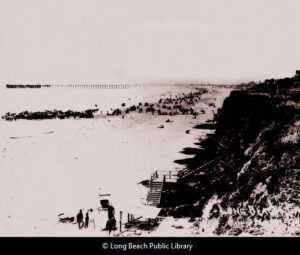
The power generated was used in operating a pump which forced sea water to an elevated tank. From there the water was piped back into a turbine wheel, which created power for running electric dynamos and other machinery. What differentiated Gerlach’s invention from the 178 other U. S. wave motor patents was the shaft and pulley which were driven in only one direction by the paddles. Unfortunately, his was motor just didn’t have enough “oomph” to pump sea water to the top of the high bluffs near the pier. The project was abandoned. However Gerlach, didn’t give up. By 1896 he had moved to Santa Cruz, had perfected his generator and, according to the press, his generator was to be put into operation within two weeks (LAT 1/16/1896 p. 11)
In January and in March 1896 newspapers reported successful tests of the Gerlach wave motor but on June 3rd the project was announced to be a failure in a brief, sad paragraph in the Santa Cruz Daily Sentinel. “The Gerlach Wave Motor at Capitola does not allow itself to be disturbed by the waves. This we regret. Its success meant cheap power and an electric railroad from Capitola to Santa Cruz and from this city to the metropolis. It meant more − a mechanical revolution so vast as to be beyond the powers of comprehension.”
In October 1908, Dr. Clinton A. Burrows was granted permission to build his own pier near the end of the new Pine Avenue Pier (which replaced the “old” pier in November 1904). In exchange he would install his wave motor, which he claimed would produce one hundred horsepower. This power could then be transferred into electric light and power. In return, he asked for a contract to produce electricity for the city, and for approval to string electric wire to deliver his “wave generated” product to homes and businesses throughout Long Beach.
Burrows’ wave machine consisted of a huge float suspended on wire cables that passed over ratchet wheels. With the incoming breakers the float was raised and lowered and by means of the cable the power could be transmitted to shafting which could be connected with any sort of machinery. In September 1908 his machine attracted a large crowd, when the loud grinding sound it generated permeated the entire pier. The equipment worked, but hadn’t generated any power. Burrows lowered his expectations. His goal was to initially produce one horsepower of energy, hardly the one hundred he promised. Burrows said it would only be a matter of time before more power was produced. He also promised to oil the equipment.
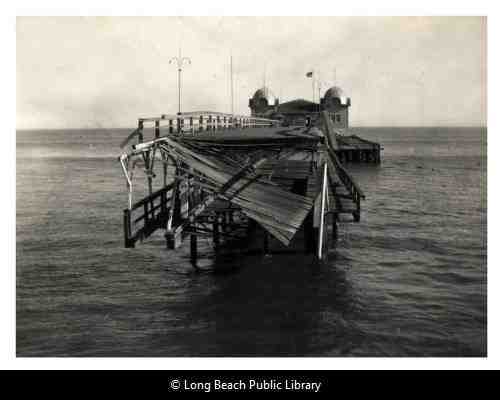
Hard luck followed. In February 1909 heavy seas tore the motor from its moorings before his generator was fully functional. Long Beach was lucky. Its pier survived, though barely. Not so the one in Redondo Beach which housed the $100,000 ($3.56 million in 2024) “Starr Wave Generator.” The Daily Telegram reported Redondo Beach’s wave machine “went with a lump of sugar into the sea. The pier went first, until not even a scrap remained.” (2/13/1909). Fred Starr tried to rebuild, but investors weren’t interested. Most of his money had come from San Francisco businessmen, who were now using their funds to rebuild the city following the devastating 1906 earthquake.
In Long Beach, Burrows also faced financial problems. Besides losing equipment to heavy seas and San Francisco investors, what he had achieved did not live up to his promises. Burrows decided to give up his wave generating venture. Instead, he returned to Lemoore, California, and his medical practice.
Alva Reynolds
Alva L. Reynolds had always been an inventor. In 1905, before getting into wave power, Reynolds designed hand gears resembling oars for a balloon he called the “Man Angel.” Reynolds’ devise allowed a balloonist to land without the balloon releasing gas. In 1906, the “Man Angel” ran into electric wires and was destroyed. Reynolds turned his inventive mind to other pursuits.

In 1907, Alva decided wave energy was the way to the future. All he needed was a pier to perfect his wave generator and money. His brother George was a lifeguard at the Huntington Beach bathhouse and with George’s connections they found investors for their California Wave Company. In 1909, they secured a contract to use a 500-foot pier at the end of 21st Street in Huntington Beach. Here they erected an experimental wave motor generator. The equipment was put in place, but a dispute arose as to how much of the pier Alva could use for his research. He wanted it all. The Huntington Beach Company, owners of the pier, did not agree. The two soon parted ways. He turned his eyes towards Long Beach.
So confident was Alva in his wave generator, that in 1911 he requested permission to build a 1500-foot pier at the foot of Linden to be used exclusively for his company. Long Beach didn’t like the “exclusively” part of the proposal, and denied his petition. Reynolds threatened to move elsewhere, with his newly established Globe Wave Power and Electric Company, but he soon learned other cities weren’t interested in having a pier built for his exclusive use.
He came up with another solution. A compromise. He would remove the stumps of the Magnolia Avenue Pier (Long Beach’s first pier, built in 1885 and largely destroyed in 1887) and build a new one 1000 feet long. He agreed to allow concessions, and a boat loading dock at the end of the pier and said he would pay the city 2% of any profits made from the businesses on the pier. This request was also denied.
An opportunity again presented itself when it was felt a searchlight needed to be placed on the roof of the Sun Parlor at the end of the new Pine Avenue Pier. Reynolds proposed providing free power for the light if he was allowed to build an extension from the pier for his equipment. In addition, he could power a miniature railroad along the pier. This too was refused.
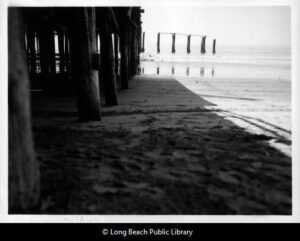
For two unsuccessful years Alva tried to find a Long Beach location for his wave equipment. Though his heart was in creating a new electrical source, he also realized that a solution was needed to combat teredos, shipworms known as termites of the sea, eating away wood pilings on piers. Unprotected pilings would only last a few years, which proved the case in many early piers. That would not have happened with Alva’s newest creation − his “Common Sense Pile Protectors.” His patented device consisted of a jointed ring, or endless chain which loosely circled the pilings, buoyed up by two floats. By tidal action the protectors broke up existing colonies of wood borers, prevented new infestation, scraped away barnacles, mussels and other undesirable marine growth.
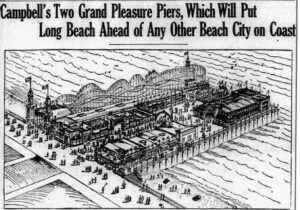
Reynolds was not one to give up. In 1913, he learned E. B. Campbell was planning two private amusement piers in Long Beach, one at the foot of Chestnut, the other off Cedar. At Cedar Avenue, Campbell planned to erect a roller coaster (later called the Jack Rabbit). The Chestnut pier would house a theater. After securing a 35-year franchise contract with the Strand Company, which owned the land between the new Pine Avenue Pier and Chestnut Avenue, Campbell formed the Neptune Pier Company. He soon realized his plans exceeded his pocketbook. He needed more capital. In 1914, Campbell convinced Morgan Adams to take over development of the Chestnut Avenue venture. Adams formed the Pleasure Pier Company and his pier became known as the “Pleasure” pier. Not so simple was naming the Cedar Avenue pier. In the course of its history it was referred to as Campbell, Neptune and Jack Rabbit.
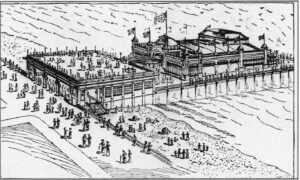
With two new piers, things looked promising for Alva Reynolds. In 1915, he turned to Campbell’s Neptune Pier Company and asked to secure space on the Cedar Avenue pier. In exchange Reynolds promised to furnish his latest invention, the “Common Sense Pile Protectors.”
Reynolds proposed providing and maintaining pile protectors if allowed space on the pier for his wave motor. In addition, he would furnish electricity to light the pier and the searchlight on top of the coaster. As a bonus, he would create a salt water fire supply system for pier protection. Campbell agreed after hearing more about Reynolds’ wave generator and seeing a model in operation.
What made Reynolds’ wave generator “unique” was utilizing hydraulic transmission which allowed him to install in units and take power from acres of wave energy, bringing it into one power house under common control, in water under pressure. From that point on the process of converting the power into electricity was the same as it would be for hydroelectric.
Reynolds’ wife Florence even wrote a 72-line poem which urged investors to come look at the machine:
“Would you like to know what the wild waves are saying
As they rush back and forth, rolling, gamboling, playing?
Then listen to their story, listen to their song…
Go down to 300 Strand, they will tell it to you.
How waves can be harnessed – this lesson they’ll teach.
In the great State of Cal. And the City, Long Beach.”
In 1917, Reynolds was able to power a pier searchlight and offer limited lighting for the pier. He also came up with a novel idea − to use his wave motor to blow a whistle to signal Long Beach lifeguards when bathers were in trouble. The public safety department saw the value of Reynolds’ machine which could generate compressed air to communicate with the guards. A code was prepared, so no matter where the emergency occurred and no matter where the guards were stationed, it would be possible to indicate the nature of the trouble, the location of the person and the general plan for rescue.
Not all his plans for water safety were implemented. He later suggested a wire bridge be built between the Cedar Avenue Pier and new Pine Avenue Pier. This would aid lifeguards in rescues and could be used as a fire exit in case any of the two piers caught on fire.
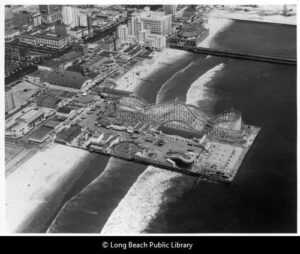
Nineteen seventeen and eighteen saw not only war but an influenza epidemic. Schools, theaters and other places where the public gathered were closed. Fifty million died worldwide, 148 in Long Beach. Business on the Pike was down; E. B. Campbell was forced to sell. He consolidated the Pleasure Pier and Neptune Pier companies, and sold them to Friedlander Amusement Bureau. The new owners planned to revitalize their recently acquired property, including adding a 30-foot extension between the two piers. They held a contest for a new name. Anna Weinrebe was the winner of a $25 ($525 in 2024) prize for suggesting the name “Silver Spray.” The two piers had become one.
Reynolds turned his attention to his pile protector company, even travelling to Canada to drum up business. Installation and upkeep of the equipment proved profitable, until others looked to creosol as a better option to protect pier pilings.
Later in life, Reynolds became a proponent for a national flood control program, becoming secretary of the National Flood and Reclamation Association. In 1928, he spent five months lobbying a bill to Congress which would change the method of flood control – digging deeper river bed channels instead of increasing the height of levees. The bill never got out of committee. Not one to give up, he ran for Congress later that year on the flood control platform. He was unsuccessful.
The 68-year-old inventor would pass away on July 9, 1929, at his Long Beach home. His body was cremated. Where his ashes were scattered is unknown, though I think an appropriate place would be off the ocean in Long Beach, joining the waves he had so long sought to harness.
H. P. Molander
Another wave generating enterprise centered in Long Beach was the Molander Power Company. It was started by a Swiss shoemaker turned inventor.
Twenty-five-year-old Hans Peter Molander came to the United States from Switzerland in 1904, settling in San Diego. He turned to the profession in which he had been trained − making shoes – and opened a business.
Molander knew shoemaking was becoming mechanized and wanted to keep up to date on new developments. He looked for new ideas in various magazines such Mechanics for Young Americans, which gave detailed plans for building many devices. He also become enamored with the Pacific Ocean. Perhaps the 1905 edition of the magazine, which gave plans for a simple wave motor, inspired ideas of using the motion of the ocean as a new power source. A fire in 1907 changed the course of his career and life. Instead of rebuilding his shoe business he took the $1000 ($34,400 in 2024) he received in insurance to pursue a dream – building a wave generator.
With his insurance money he built a model, but realized he needed a promoter to convince investors his machine was worth their money. He took on G. F. Mander as a salesman, and soon ads began to appear in newspapers asking potential investors to visit him and see his prototype in operation.
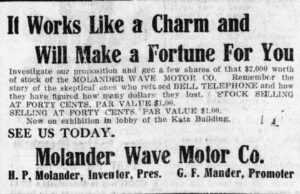
By 1913, Molander had over 500 stockholders, and established a plant on the recently rebuilt Fraser Pier in Ocean Park (located between Santa Monica and Venice). With the ability to light the pier and its concessions, Molander’s firm received favorable reviews. The company began to lease out patents on a royalty basis to others in Oregon, Washington, Hawaii, and San Diego. However, in December 1915 another fire (the first fire had been in 1912) destroyed half of Fraser Pier. Molander decided to move to Long Beach.
In October 1916, Molander Power Company began constructing a $25,000 ($737,000 in 2024) wave motor plant to produce electric power on a commercial basis. A large steel wheel, twenty-four feet in diameter, was pivoted in the center reaching half way above and below the floor on the southeast end of Long Beach’s Chestnut Avenue Pleasure pier. On it a long steel arm was extended to the surface of the water, a 10 x 14 foot paddle was fixed on this extension. With the wash of the breakers, and currents, the wheel was cradled on its pivot, and from the motion, electricity was generated. In the opinion of experts, Molander overcame the great difficulty of perfecting a transmission clutch, which no other inventor had been able to overcome.
Though still in the experimental stage, in November 1919 Molander was able to provide light for the Silver Spray dancing pavilion (the Cedar and Chestnut piers had been joined together in 1918 to form the new Silver Spray Pier) when the electricity in the city went out for more than two hours. A frantic call from the pavilion manager signaled a test run. Though the sea was calm and the wave motor was scarcely working, there was enough electricity stored in the batteries to have lighted the entire pier. However, lighting applications of his wave power was not his goal. He wanted to power factories.
In December 1919, Molander’s wave generator was featured in the magazine Popular Mechanics. It read in part: “Wave motors, designed to utilize the wasted energy of the sea, are usually looked upon as merely a possible future development, and it is not generally known that a successful apparatus of this kind is in actual operation in Long Beach, California.” (Long Beach Press 12/22/1919)
The article generated the interest of newsreel producers who filmed Molander’s operation under the caption “First successful wave motor installed in Long Beach, California.” (Daily Telegram 3/9/1921). It was great publicity for not only Long Beach, but the Hotel Virginia, which was seen in the background.
With such favorable reviews, the Molander Power Company attracted additional investors and raised capital to expand operations. In March 1921, they announced plans to install a chlorine and caustic soda manufacturing plant capable of making a profit of $150,000 ($2.63 million in 2024) per year. The firm already had a 15-year lease on a part of the Silver Spray pier and this new facility would cover 12,000 square feet of that space. A process of electrolysis would be used to break up the salt into chlorine and soda. Not having to pay for electrical power, which would be furnished by 12 wave motors, Molander said he would be able to sell his products at an extremely low price. It was expected that within a year after the plant was operational, it would employ at least 50,000 men up and down the Pacific coast. All that was needed was an additional $25,000 ($438,000) in equipment to add to their current inventory valued at $50,000 ($876,000).
But the timing was not right. A few months later oil was discovered on Signal Hill. Investors now turned their attention, and pocketbooks, away from wave power to oil. A new era of energy production had begun.
—–
More than one hundred years later, that “new era” of petroleum production is facing dwindling resources and environmental concerns. Solar, wind and hydroelectric power have been harnessed for energy, but perhaps it’s time to reconsider the sea. Hopefully the new Eco Wave Power project at San Pedro will be successful. Will wave energy be providing power to thousands of homes and businesses in the future? Things look promising. Recent state legislation, Senate Bill 605, directs California to create a comprehensive road map for wave energy.
Categorized under: